
Research Strategy
Research Strategy
The new research program of the Division aims to contribute to agricultural development by providing policy-relevant knowledge on the social, institutional and political dimensions of agriculture in developing countries. The Division’s research program will have a multi-disciplinary thrust and combine research approaches developed in agricultural and institutional economics, rural sociology, political science, and related disciplines.
The research program is guided by the vision of a future world agriculture that is able to feed a growing human population, use its great potential to contribute to poverty reduction, provide environmental services instead of overusing natural resources, and contribute to solving the major challenges of the 21st century: managing climate change, improving energy security; combating pandemic diseases; and reducing armed conflicts.
The research program is based on the premise that to fulfill this vision, agricultural development will have to rely on
- empowered rural communities that give voice to the poor;
- functioning markets that are accessible to smallholder farmers; and
- effective and responsive state institutions that are able to address market failures and provide the public goods and services on which agricultural development depends.
The Division aims to contribute to achieving these goals through cutting-edge empirical research, guided by theories and analytical concepts developed in relevant social science disciplines. See list of publications for examples. The figure below displays examples of potential research topics that will be pursued under the Division’s new research program.
Examples of potential research topics
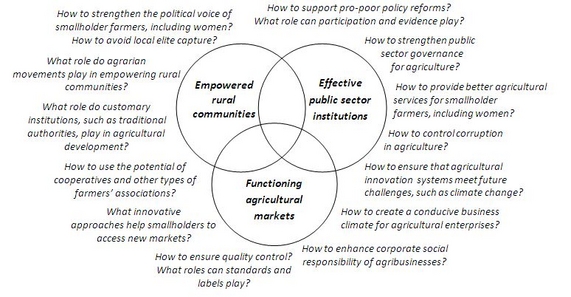
As the examples of research topics show, the program aims to address the governance challenges of agricultural development that arise in the public and the private sector, and in rural communities and non-governmental organizations. Based on the insight that there are no “one-size-fits-all” solutions, the Division’s research program will concentrate on the question: “What works, where and why?” Accordingly, the research agenda will be pursued in a set of focus countries that differ with regard to their political systems, social structures, agroecological conditions and level of economic development. In pursuing its research agenda, the Division will closely cooperate with local research organizations and stakeholders and engage in research communication and policy dialogue.